Vegas to Wall Street: Luck, Lies, and Loss
Andrew Grevett·10 min


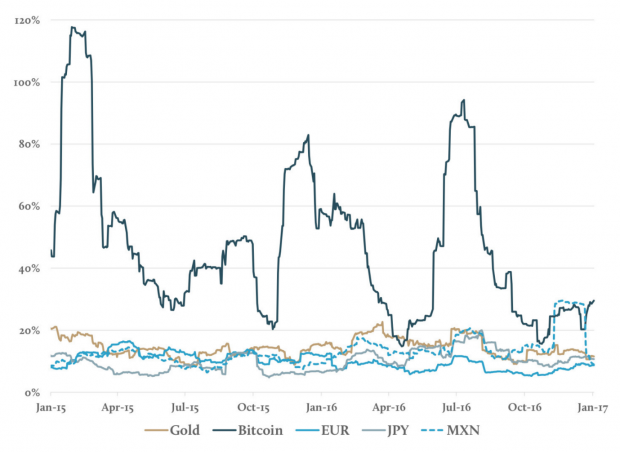 Annualized standard deviation of daily returns, 30 day rolling (Source: Goldmoney)[/caption]
Bitcoin’s volatility is several orders of magnitude greater than gold, as well as every other asset classes.
Bitcoin’s often violent price swings make it highly unsuitable as a stable form of money. It also renders the “store of value” argument effectively redundant. Sure, putting your putting your money into bitcoin during periods of higher risk may protect it against inflation. But what use is that if the value of bitcoin itself is so excessively erratic?
What’s more, much of that volatility can be attributed to the 'trials and tribulations' that bitcoin has undergone during its short lifespan. It has already been lumbered with a lot of bad press, which has underpinned some of the boom-bust cycles it has experienced thus far.
During its early existence, it invited a whole heap of black market activity, especially into the infamous bitcoin-powered underground marketplace Silk Road, which had to close down in October 2013. And then Mt. Gox, the world’s biggest bitcoin exchange at the time, filed for bankruptcy and shut down after being hacked for $460 million worth of the digital currency.
Such a checkered history continues to pose major question marks over bitcoin’s stability and reputation as a legitimate investment product. While it holds the benefit of being secured by the blockchain, which provides security when transactions are being made, some of the world’s biggest exchanges continue to be vulnerable to hacks.
That being said, volatility remains the lifeblood of financial markets – it enables investors to earn supernormal returns in a short span of time. And that makes bitcoin, and indeed most other cryptocurrencies, such attractive investment opportunities. This is the crucial argument in favour of Bitcoin – as a lucrative investment, it has clearly outshone gold over the last few years. Indeed, it has been the world’s best-performing currency of both 2015 and 2016 (beating every fiat currency in operation), and looks well on course to be the winner this year as well.
It would seem things are only going to get a lot better as we unleash the potential of blockchain – once the technology is discovered by more people, more companies, more central banks and more governments - the demand for cryptocurrencies could well take off.
Gold, however, has rarely proven to be an investment that delivers superior returns over a consistent period of time. A recent analysis shows that in the last 40 years, the precious metal has only topped the annual performance table of common US assets on 6 occasions. That puts it behind commercial real estate (REITs, 11 times), foreign stock markets (9 times) and US equities (7 times). Moreover, it has been the worst performer no less than 9 times, which is worse than for any other major asset classes.
This reinforces the view that few investors choose gold in hopes of reaping huge gains; rather, it is sought after for safety purposes during times of market turmoil. Bitcoin, on the other hand, could offer all the features of a desirable safe haven asset and be chosen as an attractive investment in its own right. Although only time will tell, if such a hypothesis holds true, then a concerted switch by investors from gold to bitcoin may well transpire.
Annualized standard deviation of daily returns, 30 day rolling (Source: Goldmoney)[/caption]
Bitcoin’s volatility is several orders of magnitude greater than gold, as well as every other asset classes.
Bitcoin’s often violent price swings make it highly unsuitable as a stable form of money. It also renders the “store of value” argument effectively redundant. Sure, putting your putting your money into bitcoin during periods of higher risk may protect it against inflation. But what use is that if the value of bitcoin itself is so excessively erratic?
What’s more, much of that volatility can be attributed to the 'trials and tribulations' that bitcoin has undergone during its short lifespan. It has already been lumbered with a lot of bad press, which has underpinned some of the boom-bust cycles it has experienced thus far.
During its early existence, it invited a whole heap of black market activity, especially into the infamous bitcoin-powered underground marketplace Silk Road, which had to close down in October 2013. And then Mt. Gox, the world’s biggest bitcoin exchange at the time, filed for bankruptcy and shut down after being hacked for $460 million worth of the digital currency.
Such a checkered history continues to pose major question marks over bitcoin’s stability and reputation as a legitimate investment product. While it holds the benefit of being secured by the blockchain, which provides security when transactions are being made, some of the world’s biggest exchanges continue to be vulnerable to hacks.
That being said, volatility remains the lifeblood of financial markets – it enables investors to earn supernormal returns in a short span of time. And that makes bitcoin, and indeed most other cryptocurrencies, such attractive investment opportunities. This is the crucial argument in favour of Bitcoin – as a lucrative investment, it has clearly outshone gold over the last few years. Indeed, it has been the world’s best-performing currency of both 2015 and 2016 (beating every fiat currency in operation), and looks well on course to be the winner this year as well.
It would seem things are only going to get a lot better as we unleash the potential of blockchain – once the technology is discovered by more people, more companies, more central banks and more governments - the demand for cryptocurrencies could well take off.
Gold, however, has rarely proven to be an investment that delivers superior returns over a consistent period of time. A recent analysis shows that in the last 40 years, the precious metal has only topped the annual performance table of common US assets on 6 occasions. That puts it behind commercial real estate (REITs, 11 times), foreign stock markets (9 times) and US equities (7 times). Moreover, it has been the worst performer no less than 9 times, which is worse than for any other major asset classes.
This reinforces the view that few investors choose gold in hopes of reaping huge gains; rather, it is sought after for safety purposes during times of market turmoil. Bitcoin, on the other hand, could offer all the features of a desirable safe haven asset and be chosen as an attractive investment in its own right. Although only time will tell, if such a hypothesis holds true, then a concerted switch by investors from gold to bitcoin may well transpire.
 The digital nature of bitcoin also makes it favourable vis-à-vis gold. Ownership of bitcoin can be transferred directly between parties with little effort and cost. Bitcoin trading is a straightforward process, requiring little more than the “address” of your trading counterparty and the requirement to pay a negligible transaction fee. Transferring gold ownership, however, requires the payment of management fees, particularly when buying gold-backed exchange traded funds; while buying physical gold also requires delivery, storage in a vault or safety deposit box, and insurance in many cases, all of which incur sizable fees.
Complements rather than substitutes?
Is Bitcoin’s astronomical rise in recent months happening at the expense of gold?
Some believe so. "Cryptocurrencies are cannibalizing demand for gold," was the assertion by Fundstrat Global Advisors. Fundstrat sees Bitcoin skyrocketing to at over $20,000 by 2022, and under the most bullish test scenario it could head as high as $55,000 over the same period. Clearly if such predictions are true, it would make the cryptocurrency a much more attractive prospect than gold. And imagine if central banks soon start buying up Bitcoin, similarly to the way they accumulate gold reserves at present. That would surely be a game changer.
But does gold still have a place in investors’ portfolio? Absolutely. Gold is almost certain to be around 100 years from now. The metal’s permanence is reflected in its real-world tangibility. It has survived for 5000 years as a currency, and is likely to do so for many more years. The same can’t be said for bitcoin with anywhere near as much certainty, which has generated more controversy in the last 8 years than gold has in the last 50 years.
Even in today’s market, gold remains responsive to market uncertainty - Trump’s recent “fire and fury” threats regarding possible military action against North Korea, for instance, has prompted considerable buying of the yellow metal. And while gold is still considered to be volatile, its lack of volatility compared to bitcoin will continue to be a highly sought-after feature for those simply wanting to maintain the value of their funds in a tried and tested manner.
Ultimately, it boils down to investor preference. While bitcoin and gold do share a lot in common, there are also distinct differences that make one more appealing than the other. If you’re looking for somewhere to park your money for the long term, gold continues to be a proven safe haven solution, as do other precious metals such as silver, platinum and palladium. But if your investment horizon is more short-term, and/or you are less averse to volatility exposure, then bitcoin or a number of other cryptocurrencies may well be the answer.
So rather than substitutes, perhaps a more accurate way to describe the relationship is complementary. Thanks to bitcoin’s ongoing propulsion into the mass consciousness, investors now have a wider range of assets from which to make a choice. The future may hold even more options; for instance, the UK’s Royal Mint will soon introduce a gold-backed cryptocurrency – a tradable digital token that represents ownership of physical gold that is held in the company’s vaults. Such a product would be a hybrid solution, combining some of the best features of cryptocurrency and gold. We will have to wait and see how this would play out in the real world.
The digital nature of bitcoin also makes it favourable vis-à-vis gold. Ownership of bitcoin can be transferred directly between parties with little effort and cost. Bitcoin trading is a straightforward process, requiring little more than the “address” of your trading counterparty and the requirement to pay a negligible transaction fee. Transferring gold ownership, however, requires the payment of management fees, particularly when buying gold-backed exchange traded funds; while buying physical gold also requires delivery, storage in a vault or safety deposit box, and insurance in many cases, all of which incur sizable fees.
Complements rather than substitutes?
Is Bitcoin’s astronomical rise in recent months happening at the expense of gold?
Some believe so. "Cryptocurrencies are cannibalizing demand for gold," was the assertion by Fundstrat Global Advisors. Fundstrat sees Bitcoin skyrocketing to at over $20,000 by 2022, and under the most bullish test scenario it could head as high as $55,000 over the same period. Clearly if such predictions are true, it would make the cryptocurrency a much more attractive prospect than gold. And imagine if central banks soon start buying up Bitcoin, similarly to the way they accumulate gold reserves at present. That would surely be a game changer.
But does gold still have a place in investors’ portfolio? Absolutely. Gold is almost certain to be around 100 years from now. The metal’s permanence is reflected in its real-world tangibility. It has survived for 5000 years as a currency, and is likely to do so for many more years. The same can’t be said for bitcoin with anywhere near as much certainty, which has generated more controversy in the last 8 years than gold has in the last 50 years.
Even in today’s market, gold remains responsive to market uncertainty - Trump’s recent “fire and fury” threats regarding possible military action against North Korea, for instance, has prompted considerable buying of the yellow metal. And while gold is still considered to be volatile, its lack of volatility compared to bitcoin will continue to be a highly sought-after feature for those simply wanting to maintain the value of their funds in a tried and tested manner.
Ultimately, it boils down to investor preference. While bitcoin and gold do share a lot in common, there are also distinct differences that make one more appealing than the other. If you’re looking for somewhere to park your money for the long term, gold continues to be a proven safe haven solution, as do other precious metals such as silver, platinum and palladium. But if your investment horizon is more short-term, and/or you are less averse to volatility exposure, then bitcoin or a number of other cryptocurrencies may well be the answer.
So rather than substitutes, perhaps a more accurate way to describe the relationship is complementary. Thanks to bitcoin’s ongoing propulsion into the mass consciousness, investors now have a wider range of assets from which to make a choice. The future may hold even more options; for instance, the UK’s Royal Mint will soon introduce a gold-backed cryptocurrency – a tradable digital token that represents ownership of physical gold that is held in the company’s vaults. Such a product would be a hybrid solution, combining some of the best features of cryptocurrency and gold. We will have to wait and see how this would play out in the real world.Dr Chan founded DataDrivenInvestor.com (DDI) and is the CEO for JCube Capital Partners. Specialized in strategy development, alternative data analytics and behavioral finance, Dr Chan also has extensive experience in investment management and financial services industries. Prior to forming JCube and DDI, Dr Chan served in the capacity of strategy development in multiple hedge funds, fintech companies, and also served as a senior quantitative strategist at GMO. A published author at professional journals in finance, Dr. Chan holds a Ph.D. degree in finance from UCLA.