
- What's the strategy, and how does it align with business goals?
- What are your tactics?
- How will you execute the tactics?
- How will you measure?
Ripe for automation
 Penn gave several examples of processes that can be easily automated using artificial intelligence:
- Research key topics. I'm in the middle of building a new marketing trends report, and I've downloaded 40,000 articles on marketing. AI -- specifically text mining -- is helping mine what the most prominent trends and topics are in that corpus of text.
- What content works. Using a type of machine learning called Markov chains, I track which pieces of content assist conversions on my owned media properties the most. Then I optimize the daylights out of those pieces.
- Network graphs. Using Talkwalker’s data, I graph relationships between entities, then use machine learning to assess the likelihood that a Twitter account is automated. That adjusts influence scores downward based on percent automated.
- Developers to help extract data from systems.
- Data scientists to prep, clean, analyze and model the data.
- Marketing technologists to take the model outputs and put them to work in the business.
Jack of all trades
Mastering only one skill will not be good enough. “Marketers need to become multidisciplinary,” Penn said. “It's easy to automate tasks within a narrow domain, but you can't blend different domains of expertise together with AI. If you know writing, psychology, music and marketing, you're a lot harder to replace.”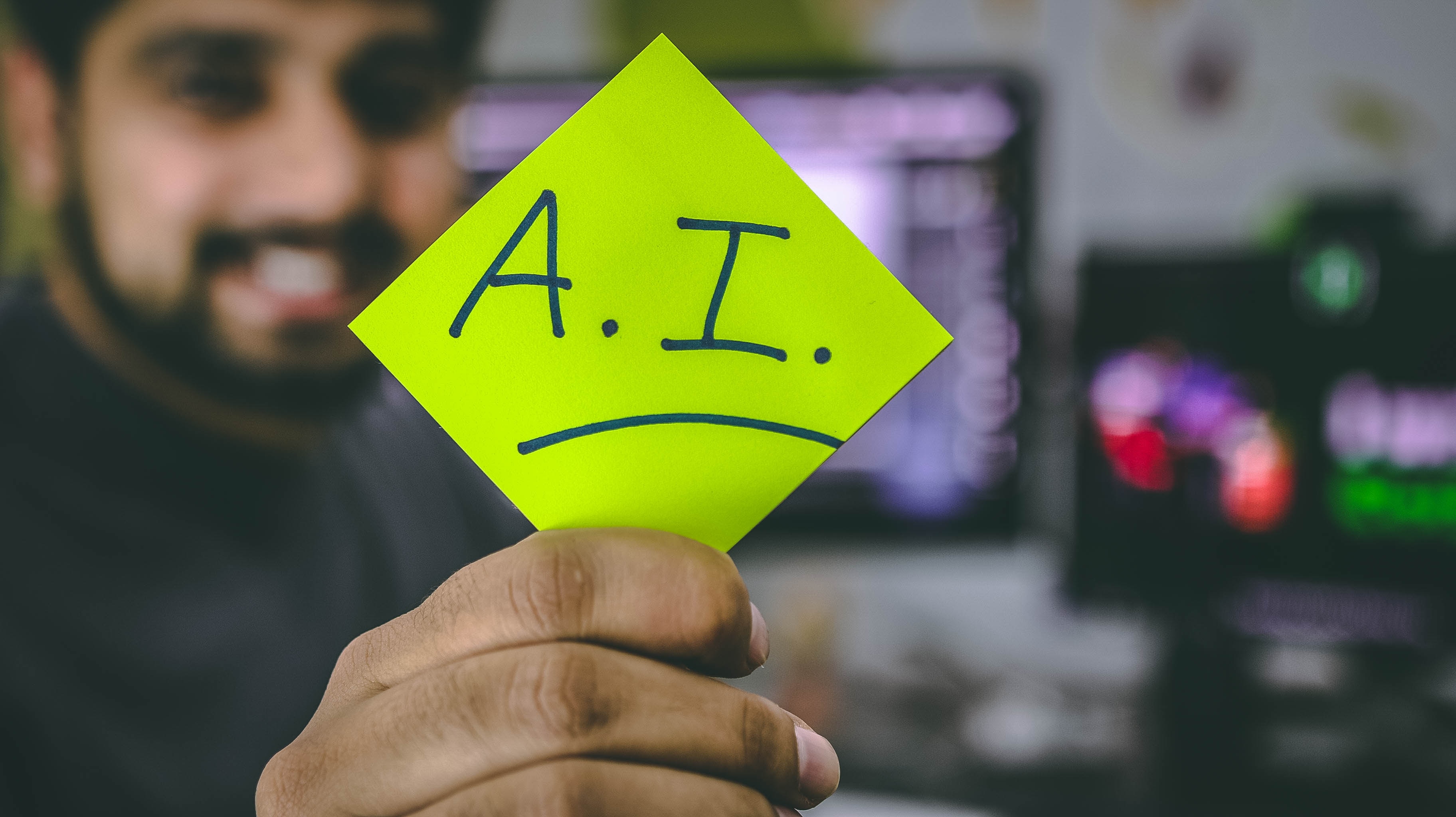 Although “artificial intelligence” sounds mystical, it is not all-powerful. There are tasks it cannot perform … for now.
“The list gets shorter every day,” Penn said. “Machines can now write credibly well, and that will get substantially better in the next 12 months. Expect machines to crank out decent blog posts, for example, at a massive scale.
“Machines can't think across domains,” he said. “That means AI will have a hard time with empathy, with human judgment tasks that ‘break the rules’ and with multi-domain expertise.”
People still have roles to play. However, they should not push their luck.
“Machines won't replace most human relationships except when your customer experience is so abysmal that dealing with a machine is preferable,” Penn said. “If a chatbot is an upgrade to your service, your service sucks. Department of Motor Vehicles, I'm looking at you.”
Content marketers would be well served to remember that “machines cannot do general life experience.”
“General life experience is broad and contains lots of different inputs,” Penn said. “Machines can't replicate that yet. It requires real sentience that they don't have. What makes us human is a mix of weird data mashed together with pattern recognition.
“Until machines can do massive pattern recognition across many different, disparate inputs, tasks that require that kind of knowledge -- like empathy -- are relatively safe,” he said.
That might be only a short-lived saving grace.
“There will come a time when we have to contend with a machine being able to do empathy,” Penn said. “When that day comes, it will be far more than a marketing problem. But we'll deal with that when it happens.”
For more about Penn’s work, he has published “AI for Marketers: An Introduction and Primer
Although “artificial intelligence” sounds mystical, it is not all-powerful. There are tasks it cannot perform … for now.
“The list gets shorter every day,” Penn said. “Machines can now write credibly well, and that will get substantially better in the next 12 months. Expect machines to crank out decent blog posts, for example, at a massive scale.
“Machines can't think across domains,” he said. “That means AI will have a hard time with empathy, with human judgment tasks that ‘break the rules’ and with multi-domain expertise.”
People still have roles to play. However, they should not push their luck.
“Machines won't replace most human relationships except when your customer experience is so abysmal that dealing with a machine is preferable,” Penn said. “If a chatbot is an upgrade to your service, your service sucks. Department of Motor Vehicles, I'm looking at you.”
Content marketers would be well served to remember that “machines cannot do general life experience.”
“General life experience is broad and contains lots of different inputs,” Penn said. “Machines can't replicate that yet. It requires real sentience that they don't have. What makes us human is a mix of weird data mashed together with pattern recognition.
“Until machines can do massive pattern recognition across many different, disparate inputs, tasks that require that kind of knowledge -- like empathy -- are relatively safe,” he said.
That might be only a short-lived saving grace.
“There will come a time when we have to contend with a machine being able to do empathy,” Penn said. “When that day comes, it will be far more than a marketing problem. But we'll deal with that when it happens.”
For more about Penn’s work, he has published “AI for Marketers: An Introduction and Primer
Jim Katzaman is a manager at Largo Financial Services. A writer by trade, he graduated from Lebanon Valley College, Pennsylvania, with a Bachelor of Arts in English. He enlisted in the Air Force and served for 25 years in public affairs – better known in the civilian world as public relations. He also earned an Associate’s Degree in Applied Science in Public Affairs. Since retiring, he has been a consultant and in the federal General Service as a public affairs specialist. He also acquired life and health insurance licenses, which resulted in his present affiliation with Largo Financial Services. In addition to expertise in financial affairs, he gathers the majority of his story content from Twitter chats. This has led him to publish about a wide range of topics such as social media, marketing, sexual harassment, workplace trends, productivity and financial management. Medium has named him a top writer in social media.