

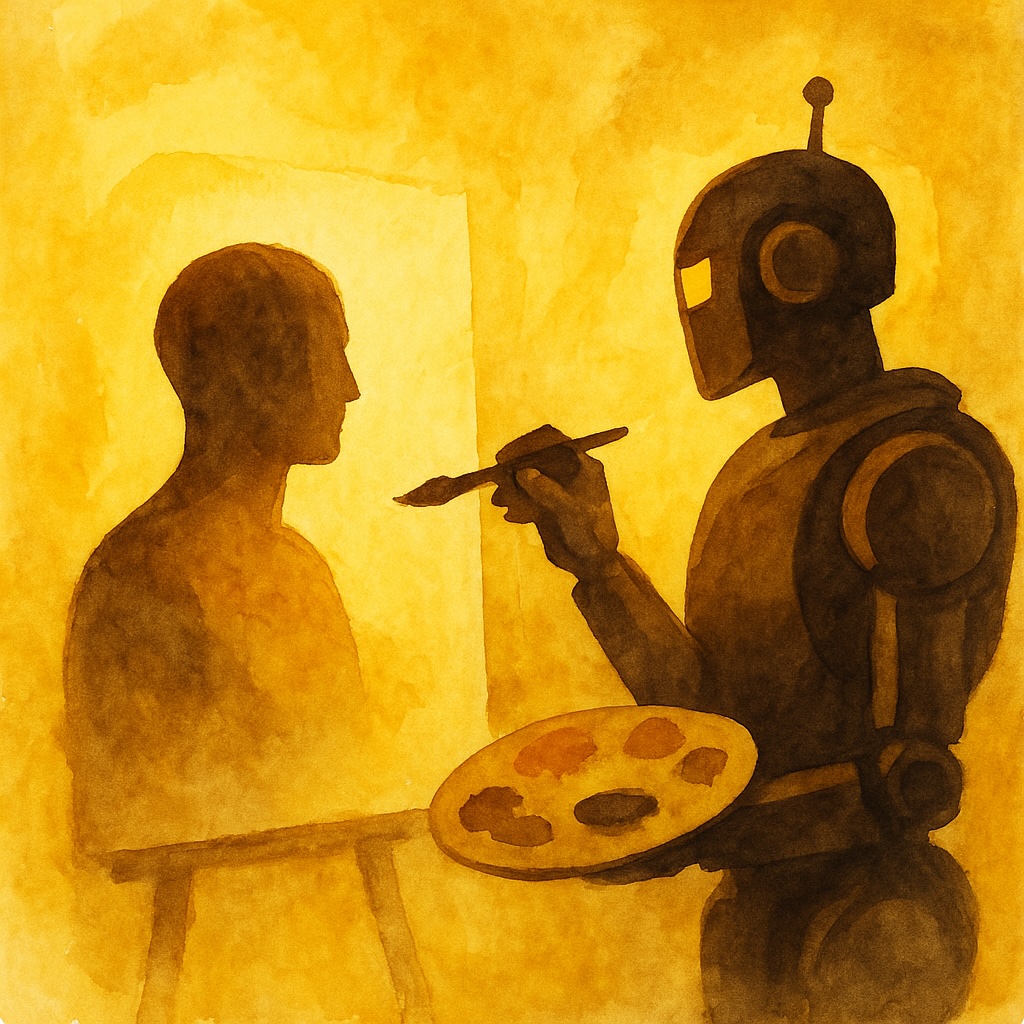
AGI won’t erase scarcity. It will relocate it — to trust, taste, and meaning. Our task is to find where the new bottlenecks hide
The day accuracy got cheap
In 1839, the daguerreotype arrived. Overnight, likeness became nearly free. What had once required weeks of painterly skill could be captured in minutes with chemistry and light. Painters didn’t vanish, but their monopoly on accuracy did. Their survival demanded a pivot: from accuracy to interpretation, from resemblance to impression, from record to style.
This pivot was not automatic. Some painters fell into obscurity. Others discovered that when one form of value collapses, another rises in its place. Style, symbolism, emotion, and meaning became scarce in ways mechanical resemblance could not touch.
This is the oldest lesson of technological disruption: when abundance floods a domain, scarcity migrates.
Now we face a similar situation. AGI is set to unleash abundance, not just of sight or sound, but of thought itself. Drafting, planning, analyzing, optimizing, checking: the work that defined “knowledge jobs” for a century can now be replicated at scale. If “being fast and precise” was the moat, the moat is draining.
The question is no longer “what can AGI do?” but “what will be left for us when it does it all?”
Abundance doesn’t erase scarcity: it displaces it.
Abundance never kills value outright. It forces it to migrate. What changes is not whether something matters, but where the bottleneck moves when the old one collapses.
The history is consistent. When photography made resemblance cheap, style and interpretation became the painter’s currency. When industrialization made raw muscle abundant, the scarce assets became coordination, design, and the capital to command them. When software dissolved the friction of distribution, value moved to permission, reputation, and trust.
Every wave rewrote the map of scarcity. The coordinates flipped. What was once the bottleneck became a commodity; what resisted automation, or gained new weight precisely because everything else became cheap, became the new premium.
AGI now floods process, speed, and precision. Drafting, optimizing, checking, and iterating: all the work once defined as “knowledge labor” is spilling over the banks. The question is not whether scarcity will survive. It always does. The question is: where does it migrate this time — and will we recognize the new coordinates fast enough to anchor ourselves there?
Likely destinations for scarcity
If abundance always displaces scarcity, then the task before us is not prophecy but detection. Where does the bottleneck migrate when machines make the old one dissolve?
There are patterns worth watching. Scarcity tends to settle in places that resist absorption for structural reasons, not sentimental ones. The domains that survive share three traits:
- High absorption difficulty. The work is messy, embodied, or ambiguous in ways that resist clean modeling.
- Concentrated tail risk. Failures at the margins carry catastrophic costs that no one wants to own.
- Heavy coordination load. Humans must still negotiate meaning, blame, or ritual in ways automation cannot shortcut.
If you trace those three traits, certain candidates start to emerge. They are not certainties, but they are plausible waypoints:
- Trust under exposure.Contracts can be drafted in seconds, but when one fails, someone must carry the heat. Not romance — enforceability. Trust has a cost, and names that can be blamed are scarce.
- Taste under scrutiny.Infinite designs are trivial. Selection with credibility is scarce. The act of curatorship, not generation, becomes the signal of value.
- Touch under fear.In medicine, caregiving, crisis response, compliance, and recovery often depend less on precision than on presence. Fear responds to bodies, not algorithms.
- Provenance under fakery.When anything can be manufactured, the story of origin becomes the product. Authenticity requires witnesses, seals, and chains of custody.
- Ritual under abundance.When necessity no longer structures time, rituals become anchors of stability. Ordeals, ceremonies, festivals — these synchronize groups in ways efficiency cannot.
- Gatekeeping under overload.When choice explodes, attention collapses. Trusted filters gain power. Not because they are perfect, but because they are legible.
This is a working map, not a final list. You don’t have to agree with the candidates. You do have to measure them. The challenge is not to dream up niches but to observe where scarcity already resists the flood — and to see if those coordinates hold when the waters rise higher.
Why is this time harder than cameras?
The painter analogy comforts us. Painters survived photography; perhaps we will survive AGI. But the parallel only carries us so far before it breaks.
Photography reshaped supply. It made likeness abundant. But it did not dictate demand. Cameras could show us what we looked like, but they could not tell us what we ought to find beautiful, or meaningful, or valuable. Painters still had room to steer public taste.
AGI may not leave us that room. It will not only generate supply. It will also anticipate and steer demand. It can learn what persuades us and then adjust its own persuasion. It does not just give us more; it tells us what to want next.
This shift changes the game entirely. Painters could migrate away from representing physical reality to style because the audience still decided what mattered. Reinvention was possible because demand was still led by humans. With AGI, demand itself can be co-designed by the machine. That makes reinvention a negotiation with something smarter, not a unilateral human choice.
So the comforting analogy becomes a warning. We cannot assume that survival is automatic, or that value migration will simply hand us a new niche to inhabit. The sharper question is no longer “where will humans find scarcity?” but “why would a superior intelligence leave us any at all?”
Working principles: hedges worth testing
The moral lens will not help here. If survival depends on sentiment, the argument is already lost. What matters is not whether humans are “special” but whether removing us makes the system weaker. That turns survival into a cost decision. We persist only if deletion raises fragility, backlash, or expense.
From that frame, five hedges emerge. Not guarantees, but principles that may resist erosion. Each of them points to where human presence could remain cheaper to keep than to erase.
1. Imperfection as insurance (Noise Value).Machines tend to fail together. Their errors co-occur when trained on the same data and optimized under the same rules. Human error is idiosyncratic. Mixing the two can de-correlate failure, buying resilience at the edge.
2. Bodies as bottlenecks (Embodiment).Some outcomes change only when a body is physically present — in trauma wards, crisis negotiations, or grief rituals. Embodiment convinces in ways dashboards cannot. Presence is itself a form of proof.
3. Names that carry heat (Liability Anchors).Systems without accountable names move fast, but they rarely endure. Signatures and faces provide legitimacy: regulators approve, counterparties sign, victims sue. A name that can carry heat is infrastructure, not ornament.
4. Performances that hold crowds (Ritual & Theatre).Societies fray when rhythm dissolves. Ceremonies of mourning, apology, or initiation stabilize groups. These are not inefficiencies; they are control loops disguised as theatre.
5. Constraints that tame the void (Constraint Gardens).Abundance corrodes purpose. Structured scarcity (quests, ordeals, apprenticeships) channels attention at a lower cost than coercion. When everything is free, constraint generates value.
These principles are not halos. They are hypotheses. Each must be tested, attacked, and measured. If they survive, they become the anchors for new roles and institutions in an economy where abundance floods the mean and scarcity hides in the tails.
The Human Equilibrium
When abundance floods the system, survival stops being a moral right and becomes a design problem. The question is no longer whether humans deserve a place, but whether their presence makes the system stronger. That is the cold, mathematical truth of equilibrium: we remain when our removal increases fragility, volatility, or distrust.
In this new economy of intelligence, machines optimize the mean — the predictable, repeatable, and measurable. Humans persist where variance, judgment, and meaning still matter. That boundary is not static; it moves with every algorithmic advance. What was complex yesterday becomes trivial tomorrow. But the space that remains — the frontier between knowing and deciding — is where conceptual work lives.
Conceptual work is not about production; it’s about architecture. It designs systems of value, defines edges of automation, and frames the narratives that give those systems legitimacy. These roles require thinking in probabilities, not instructions; in relationships, not transactions. They are the disciplines of foresight, interpretation, and constraint — the ability to shape the questions that machines then answer.
The factory of the future is cognitive, and its most valuable workers are not operators but interpreters, people who translate abundance into stability and noise into context. Their work is slower but deeper: deciding what should be optimized, what must remain ambiguous, and where meaning cannot be compressed into code. In a landscape where every process runs, only the reflective ones become indispensable.
This shift applies at every level — from executives who frame policy to frontline experts who define exception logic. The defining skill is not technical execution but systemic awareness: understanding how one’s presence influences the equilibrium of trust, risk, and accountability.
Humans who endure will not compete with machines on intelligence. They will compete on conceptual coherence — the ability to hold a system together by giving it sense, not just function. That is the new craft: the discipline of thinking in contexts where thinking still changes the outcome.
The future of work is not labor, but interpretation.