Carbon Taxes Go Global: How the EU's Climate Tariffs Are Sparking an Economic Revolution
Swagoto Chatterjee·6 min


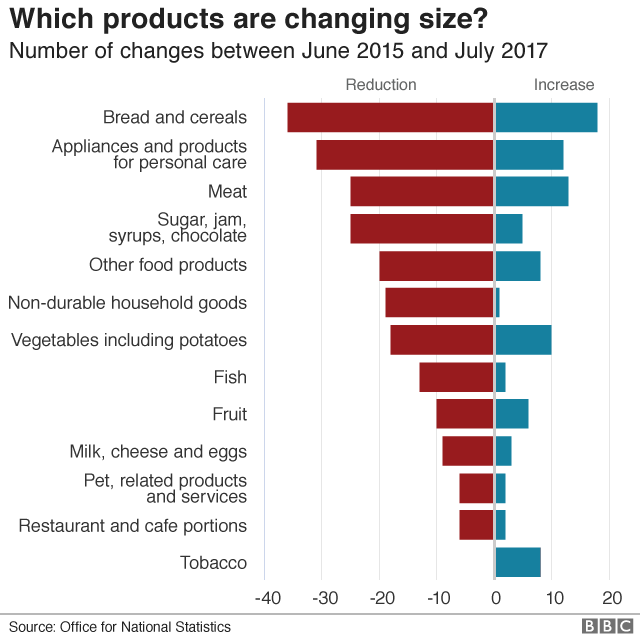 Coming back to the topic of shrinkflation - it is a form of inflation which is usually restricted to a certain segment of the economy, mostly pertaining to the food & beverage industry. In simpler words, the sticker price of a certain item remains the same while the size of the product is reduced, thus increasing the unit price of the item. Most consumers like you & me are much more prone to checking the variation in price. While a small price change in an item makes us think twice about buying the item, a similar size reduction usually does not have the same effect. The producers, therefore, use this strategy to keep customers buying their product albeit at a higher unit price without them noticing. The "shrink" part pertains to the reduction in the size of the item, inflation, on the other hand, rises still (even with the constant price of the item), as the unit price goes up due to the shrinkage.
Shrinkflation has been most striking in the UK in recent times. Britain's Office for National Statistics (ONS) calculated that between September 2015 and June 2017, there were 206 products that shrank in size and 79 that increased in size. Many economic analysts are of the opinion that this was mostly due the dramatic decrease in the value of Sterling Pound which lost 20% of its value against the Greenback & other major currencies in the aftermath of the Brexit vote. With the drop in the value of the Pound, retailers in the UK faced rising input costs. With the price competition increasing among the supermarkets, they resorted to reducing pack sizes to increase revenue, low wage growth post the 2008 financial crisis & government's push towards healthier products & smaller portion sizes are some of the other reasons shrinkflation as become such an established trend in the UK.
The Office for National Statistics uses the following formula based on price relatives to calculate the effect of shrinkflation on the unit price of the related items. A new base price is computed based on the current price and new & old weight of the item. For this example, we take the unit price of an item to be priced @ $1.00 with the older weight as 100 grams & the new weight as 90 grams.
➥ New base price = Current base price * (New weight / Old weight)
➥ New base price = (1.00) * (90/100)
➥ New base price = 0.900
From this new base price, we calculate the new price relative which gives the unit price for this particular item with the shinkage in size from 100g to 90g.
➥ New Price Relative = Current price / New base price
➥ New Price Relative = 1.00/0.900
➥ New Price Relative = 1.11
As you can see clearly, the unit price of the item has increased from $1.00 to 1.11 with the decreased packaging size thus exhibiting shrinkflation. This concept can be pretty much applied to any item in any economy to calculate the shrinkflation. At the end of it all, the poor consumer pays the price as the corporations find yet another way to make more profits - Capitalism at its best!
Email?| Twitter? | LinkedIn?| StockTwits? | Telegram?
Coming back to the topic of shrinkflation - it is a form of inflation which is usually restricted to a certain segment of the economy, mostly pertaining to the food & beverage industry. In simpler words, the sticker price of a certain item remains the same while the size of the product is reduced, thus increasing the unit price of the item. Most consumers like you & me are much more prone to checking the variation in price. While a small price change in an item makes us think twice about buying the item, a similar size reduction usually does not have the same effect. The producers, therefore, use this strategy to keep customers buying their product albeit at a higher unit price without them noticing. The "shrink" part pertains to the reduction in the size of the item, inflation, on the other hand, rises still (even with the constant price of the item), as the unit price goes up due to the shrinkage.
Shrinkflation has been most striking in the UK in recent times. Britain's Office for National Statistics (ONS) calculated that between September 2015 and June 2017, there were 206 products that shrank in size and 79 that increased in size. Many economic analysts are of the opinion that this was mostly due the dramatic decrease in the value of Sterling Pound which lost 20% of its value against the Greenback & other major currencies in the aftermath of the Brexit vote. With the drop in the value of the Pound, retailers in the UK faced rising input costs. With the price competition increasing among the supermarkets, they resorted to reducing pack sizes to increase revenue, low wage growth post the 2008 financial crisis & government's push towards healthier products & smaller portion sizes are some of the other reasons shrinkflation as become such an established trend in the UK.
The Office for National Statistics uses the following formula based on price relatives to calculate the effect of shrinkflation on the unit price of the related items. A new base price is computed based on the current price and new & old weight of the item. For this example, we take the unit price of an item to be priced @ $1.00 with the older weight as 100 grams & the new weight as 90 grams.
➥ New base price = Current base price * (New weight / Old weight)
➥ New base price = (1.00) * (90/100)
➥ New base price = 0.900
From this new base price, we calculate the new price relative which gives the unit price for this particular item with the shinkage in size from 100g to 90g.
➥ New Price Relative = Current price / New base price
➥ New Price Relative = 1.00/0.900
➥ New Price Relative = 1.11
As you can see clearly, the unit price of the item has increased from $1.00 to 1.11 with the decreased packaging size thus exhibiting shrinkflation. This concept can be pretty much applied to any item in any economy to calculate the shrinkflation. At the end of it all, the poor consumer pays the price as the corporations find yet another way to make more profits - Capitalism at its best!
Email?| Twitter? | LinkedIn?| StockTwits? | Telegram?Faisal is based in Canada with a background in Finance/Economics & Computers. He has been actively trading FOREX for the past 11 years. Faisal is also an active Stocks trader with a passion for everything Crypto. His enthusiasm & interest in learning new technologies has turned him into an avid Crypto/Blockchain & Fintech enthusiast. Currently working for a Mobile platform called Tradelike as the Senior Technical Analyst. His interest for writing has stayed with him all his life ever since started the first Internet magazine of Pakistan in 1998. He blogs regularly on Financial markets, trading strategies & Cryptocurrencies. Loves to travel.